
Summary of greenhouse gas emissions
(carbon footprint) for the year 2025
by Laoapparel Company Limited.
Lao apparel Co., Ltd. recognizes the importance of conducting business sustainably and being environmentally responsible. In 2025, the company assessed and gathered data on greenhouse gas emissions (carbon footprint) resulting from various organizational activities to inform future planning for mitigating the impacts of climate change.
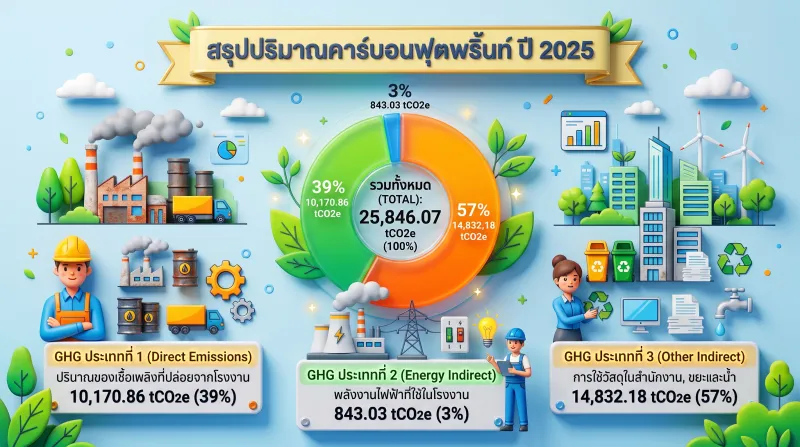
Greenhouse Gas Emissions Overview for 2025
In 2025, Lao Apparel Co., Ltd. had a total carbon footprint of 25,846.07 tCO2e, which can be broken down by type of greenhouse gas (GHG) emissions as follows:
1. GHG Type 1 (Direct Emissions) - Direct emissions
Amount: 10,170.86 tCO2e
Proportion: Represents 39% of total emissions
Source: The amount of fuel emitted from the factory, including production activities and fuel combustion that occurs within the company’s premises.
2. GHG Type 2 (Energy Indirect) - Indirect emissions from energy use
Amount: 843.03 tCO2e
Proportion: Represents 3% of total emissions
Source: Electricity used in the factory.
3. GHG Type 3 (Other Indirect) - Other indirect emissions
Amount: 14,832.18 tCO2e
Proportion: Represents 57% of total emissions
Source: The use of office materials, waste, and water, which accounts for the largest share this year.
Summary
From the statistical data in 2025, it can be seen that the majority of the company’s greenhouse gas emissions come from indirect activities in Type 3 (57%), followed by direct emissions from fuel in the factory (39%). Lao Apparel Co., Ltd. is committed to using this data as a basis for setting concrete targets and measures to reduce greenhouse gas emissions, aiming to become a low-carbon organization and promote sustainability for the environment.
Environmental Goals & Measures
Lao Apparel Co., Ltd. has established a proactive policy for managing resources within the organization to reinforce its commitment to conducting business alongside sustainable environmental stewardship. The main goals and measures are as follows:
1. Energy Reduction Measures
Timeframe: 2023 - 2028
Goal: Reduce energy consumption by 5% by 2028 (based on 2023 baseline data)
Implementation Approaches:
- Improving production machinery efficiency: Develop a preventive maintenance plan for machines and equipment in the factory regularly to reduce energy loss from abnormal operations.
- Managing lighting and air conditioning systems:
- Switch to energy-saving (LED) bulbs throughout the factory and office areas.
- Set standard air conditioning temperatures in common areas and establish clear opening and closing times.
- Employee engagement: Conduct campaigns and continuous education for employees, such as turning off lights, shutting down computer screens, and unplugging electrical appliances during lunch breaks or after work.
2. Waste Reduction Measures
Timeframe: 2025 - 2030
Goal: Reduce the amount of waste and all types of refuse by 5% by 2030 (based on 2025 baseline data)
Implementation Approaches:
- Managing production waste: Improve and plan cutting processes for maximum accuracy to reduce fabric or leftover materials (Zero Waste Design Approach), including repurposing or recycling leftover materials.
- Standardized waste segregation system: Establish clear waste segregation points in all areas (general waste, recyclable waste, industrial hazardous waste) to facilitate proper disposal or recycling processes.
- Reducing single-use plastics: Encourage employees to use personal cups and containers in the cafeteria and reduce the use of plastic bags within the organization.
- Paperless Office: Promote digital work systems to reduce paper usage and support the reuse of paper when necessary.
Lao Apparel Co., Ltd. believes that success in reducing environmental impact stems from the cooperation of all employees, and we are committed to continuously improving processes to contribute to a low-carbon society.